
NBA Player Bets in the UK: A 2026 Analyst's Guide
 Available in US
Growth of the NBA Player Prop Market in the UK
I have been pricing and modelling NBA prop lines for nine years, and I have never seen a season quite like this one. A Tuesday-night fixture between the Cavaliers and the Pistons used to draw a thin crowd of British bettors. This season I watch the volume tick up on points overs at 2 a.m. UK time and realise the audience has doubled, then doubled again.
Two things changed at once. Sky Sports took the NBA back from TNT on an eleven-year deal that began with the 2025-26 season, putting the league on a platform every football bettor already pays for. Amazon picked up the 2026 Finals exclusively in the UK and Ireland and started streaming 86 regular-season games plus the NBA Cup. The result is a younger, mobile-first British audience with access to almost every game — and a sportsbook menu that has finally caught up, offering eight to fifteen player prop markets per game with bet builders that stack three legs in twenty seconds.
Underneath that, three forces most punters do not see are reshaping the market. The first is integrity: the October 2025 indictments of Terry Rozier and Chauncey Billups detonated the NBA's prop policy and triggered the largest single rewrite of bookmaker rules in a decade. The second is tax: the Remote Gaming Duty climbs from 21% to 40% on 1 April 2026, and a new 25% General Betting Duty hits remote sports books in 2027. The third is the slow professionalisation of the British prop bettor — a generation raised on football accumulators is now reading Cleveland's pace data at midnight.
This guide is the field manual I would hand a friend who already bets the Premier League and wants to add NBA props without giving back six months of profit. It is opinionated, built around UK regulation rather than American workflow, and every number in it is sourced.
What This Guide Settles in Ninety Seconds
- UK Gross Gambling Yield hit a record £15.6 billion, with remote betting at £2.6 billion — basketball is the growth segment underneath football's £1.3 billion dominance.
- Sky Sports holds an eleven-year NBA deal from 2025-26, Amazon takes the 2026 Finals exclusively — the UK audience and prop menu have expanded together.
- The Remote Gaming Duty rises from 21% to 40% on 1 April 2026, and operators are expected to pass up to 90% of the cost to bettors via worse odds and smaller promos.
- The Rozier-Billups indictments triggered the biggest single rewrite of NBA prop rules in a decade — two-way contract props are gone, injury reports now update every 15 minutes.
- The working framework: stake 0.5-1% of bankroll per prop, hold accounts at three UKGC-licensed books, read pace and minutes before season averages, and skip the marquee fixtures where lines are sharpest.
Contents
- What an NBA Player Prop Bet Actually Is
- The Eight Core Player Prop Markets Available to UK Bettors
- How Bookmakers Price an NBA Player Prop Line
- The Size and Shape of UK NBA Betting in 2026
- UKGC-Licensed Sportsbooks That Take NBA Player Props
- Where the Edge Actually Lives in NBA Props
- Bankroll Discipline for Player Props
- Integrity, Scandals and What They Mean for Your Bet
- The 2026–2027 UK Regulatory Shift You Need to Know
- Pre-game Versus Live Player Props
- The Six Mistakes UK Bettors Most Often Make on NBA Props
- Playing Responsibly Under the UK Framework
- Frequently Asked Questions
- A Final Word on the Margin
What an NBA Player Prop Bet Actually Is
The first prop I ever placed was a points over on a backup centre I had watched in a half-empty Lithuanian arena two years before he reached the NBA. The line was 8.5. I knew his floor was 11 on any night the starter had foul trouble. The starter picked up two in the first quarter. The book did not adjust the line live. That, in one paragraph, is the whole game.
A player prop bet — short for proposition — is a wager on what an individual player will do during a specific game, independent of who wins. You are not predicting the result. You are predicting a number. Will LeBron James record more or fewer than 24.5 points? Will Jokić log over 11.5 rebounds? The book sets a line, you take the over or the under, and the wager settles on the box score.
Why bookmakers love props. A single NBA fixture generates dozens of independent markets, each carrying its own margin. Digital Sports Tech, one of the larger price providers, has put on record that player props now represent up to 85% of total markets offered per NBA game with some operators. More markets means bigger total handle and a thicker margin pool than match betting alone could produce.
The mechanics are simpler than the lingo suggests. Every market has two sides, a line, and odds attached to each side — usually clustered around 1.91 and 1.87 in the decimal odds your UK book displays by default. Your stake multiplied by the decimal odds returns gross payout if you win. The interesting questions start one layer down: some props settle on regulation play only, some include overtime, some are anytime yes/no markets, some are race-to. Always check the market rules tab before you stake — every UK operator words the small print slightly differently.
Proposition bet — a wager on an event within a game that is independent of the match result. In NBA betting, this almost always means an over/under or yes/no market on a single player's box-score performance.
One thing every new bettor needs to internalise: a prop line is not a prediction. It is a price-discovery tool. The book sets the line where it expects 50% of money on each side, then takes its margin from the overround. Your job is not to predict whether the player will hit the number. Your job is to decide whether the number, at the price offered, sits below or above the true probability you can defend with data.

The Eight Core Player Prop Markets Available to UK Bettors
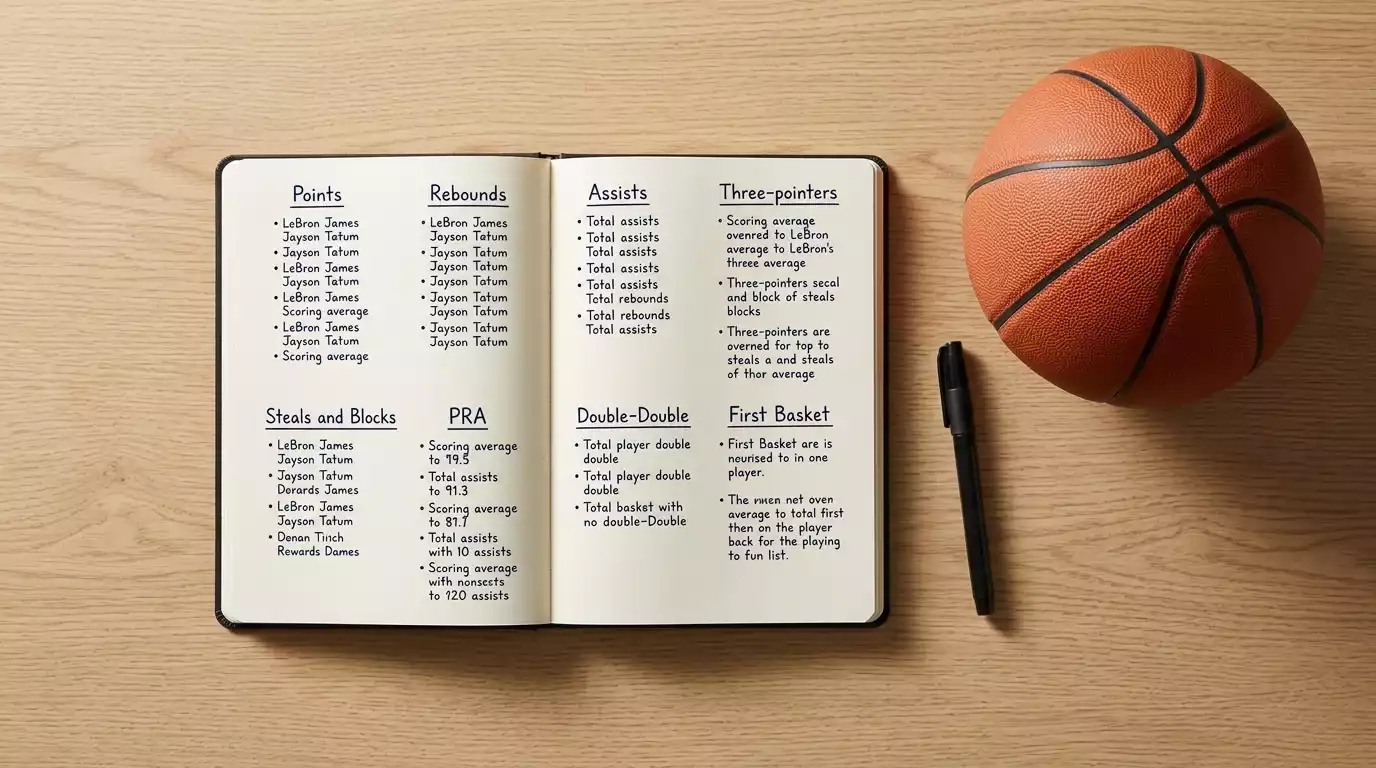
Walk into any UKGC-licensed sportsbook on game night and the prop menu unfolds like a tasting board. Points sit at the top. Then rebounds, assists, threes, the defensive stat lines. Then combos, milestones, and the strange little novelty markets. Most British bettors stop at the first three. The good ones learn to read the whole menu.
| Market | What you bet on | Why it matters |
|---|---|---|
| Points over/under | Total points scored by a named player | Anchor market, deepest liquidity, tightest margins |
| Rebounds | Total rebounds (offensive plus defensive) | Pace-sensitive, often soft on backup bigs |
| Assists | Total assists recorded | Most context-dependent of the single stats |
| Three-pointers made | Total threes converted | High variance, attempt volume beats form |
| Steals and blocks | Total defensive stops in each category | Lowest book liquidity, sharpest money |
| Combos — PRA, P+R, P+A | Sum of two or three statistical categories | Variance smooths, but vig stacks |
| Milestone — double-double, triple-double | Threshold event, yes or no | Rare-event pricing, payout-heavy |
| Novelty — first basket, race-to points | Single specific event in-game | Long-odds, recreational lean |
A worked read shows how the markets connect. Take a slow-paced Memphis-Indiana fixture where the projected total is 215 and Memphis is the home favourite. Ja Morant's points line sits at 24.5, his assist line at 7.5, his PRA at 38.5. If I expect a 12-possession swing in pace because Indiana likes to run, the over on assists becomes attractive; but the PRA combo at 38.5 might already price that swing in. Three markets, three angles, one underlying read.
Sample price spread across three UK books — illustrative only
| Market | Book A | Book B | Book C | Best |
|---|---|---|---|---|
| Points over 24.5 | 1.91 | 1.87 | 1.95 | 1.95 |
| Assists over 7.5 | 1.83 | 1.91 | 1.85 | 1.91 |
| PRA over 38.5 | 1.90 | 1.90 | 1.92 | 1.92 |
Same player, same fixture, different prices. Holding two or three UK accounts is the cheapest edge you can buy.
For a market-by-market breakdown — how points lines are constructed, why rebounds get underpriced on backup bigs, how to read the first basket scorer menu — I have written a dedicated companion piece on every NBA prop market UK books offer.
How Bookmakers Price an NBA Player Prop Line
The first time I sat in a trading room and watched a head trader build a prop line, I was struck by how little of it was opinion. He pulled up four data feeds, ran a projection model that took twelve seconds, then bumped the line up half a point because the player was facing a defence ranked top-five against his position. The whole exercise took less time than ordering coffee. The art was the half-point.
A prop line at a UK book is the product of three layers. The first is a statistical projection — the median expected output given matchup, pace, minutes and injury status. The second is a margin overlay — the book builds an overround into the two-way pricing so both sides combined imply more than 100% probability. The third is what I think of as the live edit — a human trader's adjustment for late news, public lean, sharp action and integrity flags.
The projection layer is now overwhelmingly automated. Most UK-facing operators license pricing feeds from third-party suppliers — Digital Sports Tech, Sportradar, Genius Sports — whose models ingest play-by-play, lineup data and injury reports, and produce a fair line in real time. The live edit is where it gets interesting. A trader watches the line all day. If 80% of money lands on the over within fifteen minutes, the line moves up. If a credible reporter tweets that the player tweaked an ankle in warm-ups, the line moves down or is suspended. If a known sharp account places a five-figure bet on the under, the line moves down regardless of what the model says.
Dimers, an analytical platform whose model I respect, has put this bluntly: most days the largest betting edges its model identifies belong to player prop bets rather than traditional moneylines, spreads or totals. Markets with hundreds of micro-prices have less efficient pricing than markets with one or two. The wider the menu, the more space for a stat-driven punter to spot a mispriced number.
The practical implication: prices are not opinions. They are the output of a model with known weaknesses — slow to react to lineup changes inside 90 minutes of tip-off, and consistently underpricing variance on defensive stat lines. Knowing where the model is weak is the start of finding the spots where the half-point matters.
The Size and Shape of UK NBA Betting in 2026
If you want to know how the UK actually bets, you do not need a focus group. You need the Gambling Commission's annual statistics. Total Gross Gambling Yield in Great Britain reached £15.6 billion in the most recent financial year, the highest level on record — and inside that headline lives an interesting story about where NBA props fit.
Total GB GGY
£15.6 billion — record high
Remote casino, betting and bingo
£7.8 billion, up 13.1% year on year
Remote betting GGY
£2.6 billion total
Football share of remote betting
£1.3 billion — half of all sports betting GGY
Active online accounts
24.4 million at year-end
Notice the proportions. Remote betting in Great Britain produced £2.6 billion in GGY, led by football at £1.3 billion and horse racing at £766.7 million. Everything else — basketball, NFL, tennis, cricket, golf — splits roughly £500 million of remaining yield across many sports and many books. Basketball is not the dominant market. It is the growth market.
Andrew Rhodes, the Chief Executive of the UK Gambling Commission, has flagged it directly: discussions with operators are showing a widening of the sports offering, with sports beyond traditional horseracing and football growing in use — cricket, basketball, NFL and other US-based sports. That is the regulator quoting what operators are telling him about where new revenue is coming from.
The demographic backdrop reinforces the trend. In Wave 2 2025, online betting on sports and racing was the most popular online gambling activity after lottery draws, at 10% of adults. In Wave 3 2025, 16% of UK males reported betting in the past four weeks versus 4% of females — a fourfold gender gap. Adults aged 25-34 have the highest gambling participation rate when lottery-only players are excluded, at 35%. That cohort — male, mid-twenties to mid-thirties, mobile-first, comfortable with US sports — is exactly the cohort Sky and Amazon are targeting.
The 24.4 million active online gambling accounts in Great Britain outnumber every household in the country. A material slice logs in during the NBA's prime midweek US-Eastern slate — and that overnight handle is what is fuelling the build-out of UK-facing prop menus.
Two more numbers complete the picture. The high street is shrinking — the number of licensed betting shops fell to 5,825 last year, a 1.8% decline continuing a decade-long contraction. Online real-event betting GGY rose 5% year-on-year to £596 million in the first quarter of the calendar year. The British punter is moving online, and the online punter is reaching for a wider menu.

UKGC-Licensed Sportsbooks That Take NBA Player Props
A reader emailed me last winter to ask why his prop bet on a Boston Celtics game had been voided after the player was scratched ten minutes before tip-off. He had placed it on a site he found through a Reddit thread. The site, it turned out, held a Curaçao licence, not a UKGC one. There was no UK ombudsman, no IBAS recourse, no statutory consumer protection. He never recovered the stake.
The starting filter is non-negotiable. The sportsbook must hold a Remote Operating Licence from the UK Gambling Commission. That is the only licence that brings you under UK law, IBAS dispute resolution, GAMSTOP self-exclusion and the BGC's voluntary code of conduct. Sites licensed in Curaçao, Malta-only or any other off-shore jurisdiction may be technically accessible but they offer none of the protections that make a UK account safe to fund.
What separates a good UK book from an adequate one is not the welcome offer. It is the depth and quality of the NBA prop menu. Six measurable areas frame the comparison.
What to test before depositing
- Number of distinct prop markets offered per regular-season game — a minimum of ten is the baseline for serious NBA coverage
- Whether alternate lines are offered on points, rebounds and assists, not just the standard line
- Bet builder availability for stacking same-game NBA legs, and whether it allows correlated combinations
- Live prop suspension behaviour — how often the market goes dark, and for how long
- Stake limits on player props during regular season versus playoff games
- Cash out availability on individual prop bets, not just match bets
The major UK brands that consistently offer NBA player props are well known to anyone who has bet on football here — Bet365, William Hill, Paddy Power, Sky Bet, Ladbrokes, Coral, BetMGM UK, 888sport, BetVictor, Betfair Sportsbook and Unibet all hold UKGC licences and run NBA markets year-round, each structuring its menu differently. What you will not find on any UK-facing licensed book is DraftKings or FanDuel — those operators are licensed for the US market and do not accept British customers. If a UK forum recommends them for NBA props, the recommendation is either out of date or unsafe.
Always check the footer for "Licensed and regulated by the Gambling Commission" alongside an Account Number. Without that line, you are not betting in the UK regulatory perimeter — and no amount of marketing language above the footer fixes that.
The criterion-by-criterion breakdown — how the major UK books currently compare on market depth, bet builder quality and live prop latency — sits in the companion piece on the best UK sportsbooks for NBA player props. The rule I have followed for nine years: hold accounts at three UKGC books, watch the same prop line on all three, and stake at the highest decimal odds.
Where the Edge Actually Lives in NBA Props
A friend who runs a small syndicate once put it this way: every NBA prop is a question, the book has written an answer in odds, and your job is to find the questions where the answer is wrong. Nine years in, I have not heard it described better. The edge is not knowledge of the game — every serious book has analysts who watched more film last week than you did all season. The edge is knowing which questions the model is bad at answering.
Four model weaknesses I exploit repeatedly: pace, usage rate, minutes projection and defence by position. Pace is the most underrated. The differential between a slow defensive game at about 93 possessions and a fast game at about 105 is roughly twelve extra possessions per side — twelve extra chances to accumulate a stat. Models know the pace projection but are sometimes 24 hours late adjusting when an opponent has shifted scheme since the last fixture. Usage is the next lever: when a star sits, his usage redistributes, and the line on the next-up scorer often does not move enough because the model undershoots on small-sample replacement data.
✓ Do
- Track pace projections from at least two independent sources daily
- Re-check the line within 90 minutes of tip-off for late lineup news
- Compare the same prop across three UK books and stake the best decimal
- Build a written rationale before staking — if you cannot defend it in writing, do not bet
- Focus volume on points, rebounds and PRA — the markets with the deepest sample
✗ Don't
- Bet a prop on a back-to-back without checking who sat last game
- Chase a prop because the player "feels due" — no statistical mean reverts that quickly
- Trust season averages — they hide the variance that actually drives the bet
- Stake more than 1% of bankroll on a single prop regardless of confidence
- Bet props on televised marquee games — those lines are sharpened first and hardest
Win-rate data from published 2025-26 PropellerPicks tracking is worth sitting with: when their system flagged an edge it hit blocks at 69.9%, three-pointers at 63.2%, steals at 61.9%, points at 55.7%, and PRA combos at 54.7%. The pattern is consistent — high-variance stats are harder for books to price, and a punter who can model that variance has a structural edge there.
A typical edge-finding workflow
Step 1. Pull tonight's slate. Identify two or three games where pace projections from your sources differ by more than 4 possessions per 48 minutes from the season average for the opponent.
Step 2. Inside those games, identify players whose role minutes you can defend within ±2 minutes of projection.
Step 3. For each remaining player, calculate fair line as projected minutes × per-minute stat rate × pace adjustment factor. Compare to posted line.
Step 4. If your fair line beats the posted line by 1.5 stat units or more, devig the price across three UK books and stake at the best decimal odds.
Step 5. Write a one-sentence rationale before pressing the button. If you cannot, walk away.
OddsIndex put the operational version in one sentence: "Pace and minutes are the two most important factors for NBA props. A player cannot accumulate stats if he is not on the floor, and more possessions create more opportunities." The deeper drills — calculating a fair line without paid tools, reading a usage spike in real time, spotting mispriced minutes on a bench player — live in the companion guide on stat-driven NBA prop strategy.

HoopMargin tool · workflow steps 3 & 4
The Half-Point Engine
Minutes, per-minute rate and pace go in. A fair line, a fair price and the real expected value of the posted number come out — with the bookmaker’s overround stripped out first. Illustrative model, not a tip.
The fair line clears the posted number by 1.80 pts, past the 1.64 pts this market’s own spread demands, and the best over price still pays 8.3% above fair. That is the shape step 4 of the workflow is looking for.
Model chance — over55.5%
Fair price — over / under1.80 / 2.25
Market chance, vig removed49.0% / 51.0%
Bookmaker overround4.8%
Expected value on the flagged side+8.3%
Projection cushion before edge dies0.9 pts · 1.1 min
Stake band at 0.5–1% of bankroll£2.50 – £5.00
Method. The projection is season rate per minute × minutes tonight × pace factor. Box-score counts are modelled as a negative binomial fitted to the observed spread of each market, so a points line and a blocks line are not treated as the same shape of bet. Fair price is the inverse of the model probability; the market comparison strips the overround proportionally across both sides. The cushion is how far the projection can fall before the flagged side stops paying at the price shown. Outputs depend entirely on the minutes and pace you enter. Educational tool — not betting advice. 18+, please gamble responsibly.
Bankroll Discipline for Player Props
The first season I bet props seriously I tripled my bankroll in November, then gave back two-thirds in January chasing a hot streak that was not a hot streak — it was variance dressed up as skill. The mistake was structural. I had no rule for stake size, no rule for stop-loss, no rule for cooldown after a bad beat.
The rule that survives every audit is the 0.5-1% rule. OddsIndex's strategy guide puts it cleanly: recommended bankroll discipline for NBA props is 0.5-1% of bankroll per prop. That is the operating range that keeps a positive-EV bettor in business through the inevitable 15-bet losing streak variance will produce three or four times a season.
The pre-bet checklist I run on every NBA prop
- Stake sits between 0.5% and 1% of starting-month bankroll, no exceptions
- I have a written one-sentence rationale that goes beyond "feels right"
- I have compared the price across at least two UKGC books and am taking the best
- The bet is not the third I have placed on the same fixture (correlation risk)
- I have set a daily stop-loss at 4% of bankroll and am within it
- I am not betting on a player whose status changed within the last 30 minutes
The arithmetic of unit size is harsh. At 1% stake per bet, a 50% hit rate at decimal odds of 1.91 produces a flat line. A 53% hit rate produces about 1.2% return on stake, which compounds into a real annual return. A 47% hit rate, betting confidently in 2% units instead of 1%, blows out the bankroll inside three months. The difference between profitable and bankrupt is one percentage point of accuracy and the discipline to keep stakes small while you wait for it to show up.
The 0.5-1% rule is the difference between betting as a hobby and as a structured exercise. It is also the discipline that keeps your monthly deposit volume below the £150 UKGC light-touch financial vulnerability threshold I will explain shortly.
Two operational habits convert the rule into a workable system. Keep stakes flat for at least 30 days at a time — reassessing weekly inflates stakes on wins, shrinks them on losses, and the volatility eats any analytical edge. And keep a simple log: date, market, line, odds, stake, result. What matters is that at month-end you can see what your hit rate actually is, not what you remember it being.
Integrity, Scandals and What They Mean for Your Bet
I was at my desk in October 2025 when the news broke about Terry Rozier and Chauncey Billups — a coach and a player, both indicted in connection with sports betting. The market did not flinch, but the policy memo the NBA circulated to teams two weeks later was the biggest rewrite of league prop rules I have read in nine years.
The first crack appeared in 2024, when Jontay Porter was banned for life after manipulating his own unders on a two-way contract. The league directed gambling partners to pull props on players on two-way or 10-day contracts almost immediately. Adam Silver said it directly on Amazon Prime Video's broadcast that autumn: there is nothing more important to the league and its fans than the integrity of the competition, and the indictments left him with a pit in his stomach. What changed in October 2025 was scale. The NBA memo outlined six areas for policy change — restrictions on prop types, stake limits on certain markets, elimination of single-play-determined props, tighter injury reporting and enhanced AI monitoring of betting patterns — and stated plainly that proposition bets on individual player performance involve heightened integrity concerns requiring additional scrutiny.
The injury report change that actually affects your bet. Under the new policy, teams must submit injury reports between 11 a.m. and 1 p.m. local time on game day and update NBA.com every 15 minutes, replacing the previous hourly cadence. For a UK bettor placing props in the morning, this means a line you take at 6 p.m. UK time may be standing on lineup data already obsolete by 11 p.m. The 15-minute window is the single most important operational change the new policy has introduced.
Matt King, CEO of Fanatics Betting and Gaming, captured the operator response cleanly: when the league asked operators not to offer props on two-way contract players, they did so immediately — "common sense regulation, common sense evolution, and a common sense decision." Silver, on the Pat McAfee show, said he wished there were federal legislation rather than state-by-state, and that the league had asked partners to pull back some of the prop bets entirely.
The integrity-monitoring infrastructure has scaled too. IBIA — the International Betting Integrity Association — recorded 27 suspicious betting alerts in basketball across 2025, making it the fifth-most-flagged sport. Across all sports, IBIA logged 300 alerts in 2025, a 29% increase from 232 the previous year, monitored across more than 1.5 million events covering over £230 billion in annual turnover. CEO Khalid Ali has been careful to note that the rise should not be read as direct evidence of growing integrity risk — it largely reflects stronger detection capability as the platform has expanded. On the UK side, the Gambling Commission has reported a 300% year-on-year increase in criminal cases covering betting integrity, cheating and illegal gambling.
For the British NBA bettor, the practical takeaways are three. Props on two-way or 10-day contract players are off the menu on UK books following league guidance, and the menu will narrow further. Single-play markets and micro props are in the crosshairs of the next policy wave. The 15-minute injury cadence rewards bettors who check status one final time before tip-off rather than at lunchtime. The detailed history of the Porter and Rozier-Billups cases and what each restriction means for specific market types lives in the companion piece on the integrity reset of the Rozier-Billups era.

The 2026-2027 UK Regulatory Shift You Need to Know
If I could pin a single piece of advice above every UK bettor's desk this season, it would be this: read the Autumn Budget gambling duty paper before you set your unit size for 2026. The duty changes scheduled for April 2026 and April 2027 will reshape every NBA prop price you see, and operators have already started preparing.
The Remote Gaming Duty rises from 21% to 40% on 1 April 2026 — the steepest single-step increase in UK gambling tax history. A new General Betting Duty rate of 25% on remote sports bets arrives from 1 April 2027. UK horseracing remains at 15%; offshore sports betting — meaning NBA, NFL and other US-based markets — is in scope. The combined reforms are projected to raise over £1 billion per year for UK public finances.
The UK government's own impact assessment estimates operators will pass up to 90% of the duty increases on to consumers through worse odds, reduced promos, or smaller payouts. The duty is nominally levied on operators. The economic incidence is on you.
Translated into prop-betting reality: from April 2026, expect three changes you will see on screen. Decimal odds on the over and under sides of a typical NBA points prop will compress — a market that previously priced 1.91/1.91 may move to 1.85/1.85, shifting the overround from roughly 4.7% to about 8%. Welcome offers and free-bet promotions will shrink in value or be paired with tighter wagering requirements. Boosted prices and odds-on enhancements will become rarer, especially on US sports where the duty bites hardest.
The customer-protection regime sits alongside the duty changes. The UK Gambling Commission's "financial vulnerability checks" threshold dropped to £150 net deposit per 30-day rolling period from 28 February 2025. This is the light-touch check — credit reference data only, no document upload, no friction at most volume bands.
The Betting and Gaming Council's voluntary Code on Customer Checks sits on top of that. Under the seventh edition of the BGC Code, net deposits of £5,000 per rolling 30-day period — £2,500 for 18-24 year olds — trigger an operator risk review. Enhanced due diligence applies from £25,000 a year.
The three trigger thresholds you should memorise
£150 net deposit per 30-day rolling period — UKGC light-touch financial vulnerability check.
£5,000 per 30-day rolling period — BGC voluntary code operator risk review. £2,500 if you are aged 18 to 24.
£25,000 net deposit per year — BGC enhanced due diligence tier. Source-of-funds documentation likely required.
The full regulatory roadmap — operator pass-through behaviour, where the carve-outs sit, and which UK promotion types will survive the duty rise versus which will quietly disappear — sits in the dedicated piece on UK gambling duty changes and what they mean for NBA bettors.
Pre-game Versus Live Player Props
The first time I cashed a live prop bet was on a Joel Embiid points over at half-time. He had nine at the break, the line had been bumped to 28.5, and I knew from minutes data that Doc Rivers would play him 22 minutes in the second half. The score finished at 33. The live menu opened it up.
Pre-game and live are different markets with different pricing models, different risk profiles and different operational demands. Treating them as one thing is the first mistake most new prop bettors make.
| Aspect | Pre-game props | Live (in-play) props |
|---|---|---|
| Line release | 12-24 hours before tip-off | Continuous, redrawn every possession |
| Liquidity | Deep on anchor stats; thinner on novelty | Variable; suspended during free throws and reviews |
| Margin (typical overround) | 4-6% on mainstream lines | 6-10% on most live lines |
| Information edge | Late lineup news, sharp money read | Foul trouble, hot starts, scheme reads |
| Operational demand | Research-heavy, low time pressure | Attention-heavy, high time pressure |
| Bookmaker latency | Stable lines | Three to ten seconds behind TV broadcast |
UK book infrastructure has improved sharply — most operators now offer second-half props, quarter-specific lines and foul-trouble triggers on major fixtures. What has not kept pace is the bettor's understanding of how live pricing differs from pre-game.
The single biggest difference is margin. Live overrounds run 2-4 percentage points wider than pre-game, because the book is hedging against information-flow speed. A 6-8% margin means a live prop has to be more clearly mispriced than a pre-game prop to be a positive-EV bet — a high bar, and why most successful prop bettors treat live as a supplement to pre-game work rather than a replacement. Where live wins is on event-driven mispricings: a starter picks up two early fouls and a backup eats sixteen first-half minutes, or a team comes out of a timeout running a high-pace lineup that does not match its season profile. The line will lag for three or four possessions. Those are the spots to target.
The Six Mistakes UK Bettors Most Often Make on NBA Props
I read forum threads. I read account-share posts. I read the public bet slips that British punters upload to social media in the hour before tip-off. The same six mistakes appear week after week.
✓ Do
- Bet props on weekday B-sides where the line was set hours ago and lineup news is fresh
- Compare the same prop across two or three UKGC books before staking — every time
- Build a one-sentence written rationale before pressing confirm
- Set a daily stop-loss and honour it without exception
- Treat free-bet promotions as side-income, not as a reason to bet markets you would otherwise skip
✗ Don't
- Pile into props on televised marquee fixtures — those lines are sharpened first and hardest
- Chase a stat because the player "had a quiet game last time" — that is variance, not signal
- Stack four or five correlated legs into a same-game parlay for the payout fantasy
- Bet props on players whose status changed within 30 minutes of tip-off without re-pricing
- Reload after a losing day — the variance does not know it has been mean to you
- Trust per-game averages without checking minutes — averages hide everything that matters
Two of these deserve a closer look. The marquee-game trap is the most expensive. UK bettors gravitate to Saturday-night Lakers fixtures because they recognise the names — but those are exactly the games where the book has spent the most pricing effort. The lines are sharper, the margins sometimes tighter, and public action heavier on overs which means books spend the day moving lines to balance their book. Tuesday-night Pacers-Magic gets a fraction of the pricing attention and is where most of my profit has come from over a career of placing real money.
The same-game parlay trap is the most dangerous. UK books market bet builders aggressively — three legs, five legs, ten legs. The maths is brutal: even a 1.91 price on each leg combined into five legs gives the book an overround well over 20% by the time correlation adjustments are applied. Same-game parlays can be a tool when legs are genuinely correlated and you understand the correlation — but as a recreational habit, they are the single highest-margin product on the menu.
The Gambling Commission's participation data tells a quiet story behind these mistakes. The 16% versus 4% gender gap means the cohort doing the bulk of UK betting is also the cohort most exposed to the marketing of bet builders and accumulators. The fix is recognising which products are entertainment and which are an edge — and never confusing one for the other.
Playing Responsibly Under the UK Framework
I have a rule for the last five minutes of any betting day: I put the phone face down and walk away for an hour before deciding whether to place anything else. It started after a bad night I would rather not detail. It is now the most important habit I have.
The UK framework gives you tools that, used properly, are not friction — they are infrastructure. GAMSTOP allows free self-exclusion from every UKGC-licensed operator simultaneously. Every UK book offers deposit limits, loss limits, session-time limits, reality checks and time-out periods from 24 hours to six weeks. These are not features for "problem gamblers". They are features for any bettor who treats this as a structured activity rather than a feel.
What the regulator is doing on your behalf. The UKGC's light-touch financial vulnerability check, triggered at £150 net deposit per 30-day rolling period, runs in the background using credit reference data. For the vast majority of bettors it produces zero friction. The BGC's voluntary code adds two layers: a £5,000 operator review threshold per rolling 30 days (£2,500 for 18-24 year olds) and a £25,000 annual enhanced due diligence tier.
Andrew Rhodes, the UKGC's Chief Executive, framed the regulator's mandate at the BGC Annual General Meeting: total gross gambling yield is at its highest ever level at £15.6 billion, and participation in gambling has remained stable at 48% — just under half of the adult population in Great Britain. The regulator's interest is not in shutting the market down. It is in keeping the market sustainable for the 48% who participate without harm.
If you find yourself betting larger than your unit-size plan, betting on markets you do not understand to chase a loss, or hiding your activity from people who would ask — these are not professional decisions. The free GamCare helpline is on 0808 8020 133.
The structural advice is short: pick a monthly bankroll you can afford to lose entirely. Set a deposit limit at that figure. Set a daily loss limit at 4% of bankroll. Set a session-time reminder at 60 minutes. Treat any breach as a signal to stop — not as a signal to renegotiate the limits with yourself. The bettors who survive a decade treat their own discipline as a fixed input.
Frequently Asked Questions
What is an NBA player prop bet, in plain UK terms?
A player prop is a wager on what a specific NBA player will do during a single game, independent of who wins. The book sets a line — say "Jayson Tatum points 27.5" — and you stake on the over or the under. Settlement is on the regulation box score unless the market rules tab says otherwise. The mechanics are identical to a Premier League player-shots-on-target market: a single statistic, a line, two sides, your stake against the book's odds.
Are NBA player prop bets legal in the UK?
Yes — on any operator holding a Remote Operating Licence from the UK Gambling Commission. Every major UK-facing book — Bet365, William Hill, Paddy Power, Sky Bet, Ladbrokes, Coral, BetMGM UK, 888sport, BetVictor, Betfair and Unibet — offers NBA player props year-round. Betting through an offshore site without a UKGC licence is not illegal for you as a consumer, but you lose IBAS dispute resolution, GAMSTOP self-exclusion and statutory consumer protection.
Which player prop markets are available on UK sportsbooks for the NBA?
The standard menu on a UKGC-licensed book includes points, rebounds, assists, three-pointers made, steals, blocks, combos (PRA, points+rebounds, points+assists), milestones (double-double, triple-double), and novelty markets like first basket scorer. Better books offer alternate lines on the anchor stats, race-to markets, and quarter or half-specific props. Depth varies — a serious bettor typically holds accounts at three operators.
Do NBA player props include overtime?
It depends on the market rules of the specific book, and you must check before staking. Most UK operators settle player props on regulation plus overtime — meaning a player who scores 22 points in regulation and adds 6 in OT settles at 28 for the prop. A handful of markets, particularly some quarter-specific or first-half props, exclude overtime by definition. The rules tab on the bet slip is the source of truth.
What happens to my player prop if the player is injured mid-game?
The standard rule across UKGC-licensed books: if the player participates in the game at all — even one second of court time — the bet stands and settles on the box-score result. A player who scores 4 points before exiting in the first quarter will settle a 17.5 points line as an under. If the player is scratched before tip-off and does not appear, the bet is voided and your stake is returned. The line between "did not play" and "played briefly then exited" is the source of most disputes.
How will the 2026 Remote Gaming Duty change affect NBA prop odds?
The Remote Gaming Duty rises from 21% to 40% on 1 April 2026. The UK government's own impact assessment estimates operators will pass up to 90% of the increase on to consumers — meaning decimal odds on NBA props will compress, the overround on a typical two-way market will widen by 2-4 percentage points, and welcome offers will shrink or carry tighter wagering requirements. A points prop currently priced at 1.91 on each side may move to about 1.85 on each side.
A Final Word on the Margin
The name HoopMargin is not accidental. Every NBA prop bet you place sits between two margins — the bookmaker's overround, which is the price of admission, and the analytical edge you bring, which is the only thing that turns admission into return. The bettors who lose treat the first margin as fixed and the second as optional. The bettors who win treat the second margin as the entire job.
Nine years of placing real-money NBA props has taught me the difference between profit and loss compresses to a few habits. Hold accounts at three UKGC-licensed books and compare every prop line before staking. Read pace, usage and minutes before reading season averages. Stake 0.5-1% of bankroll, no exceptions. Log every bet. Walk away from marquee fixtures and find your edge on Tuesday-night B-sides. Treat the 15-minute injury cadence as the most important operational change of the post-Rozier era, and plan your 2026 staking around a 40% Remote Gaming Duty that will compress every price you see.
NBA player props in the UK in 2026 are a more sophisticated market than two seasons ago — more liquid, more regulated, more integrity-monitored, more taxed. The British bettor who arrived through football accumulators and stayed for the prop menu has a structural advantage: the discipline learnt in eight years of Premier League weekend slips translates directly into the discipline NBA props demand. Read the five linked companion pieces, build the habits, and the margin will start to work for you instead of against you.
Read also




Published by the HoopMargin team.
