
NBA Prop Line Shopping & Price Comparisons
 Available in US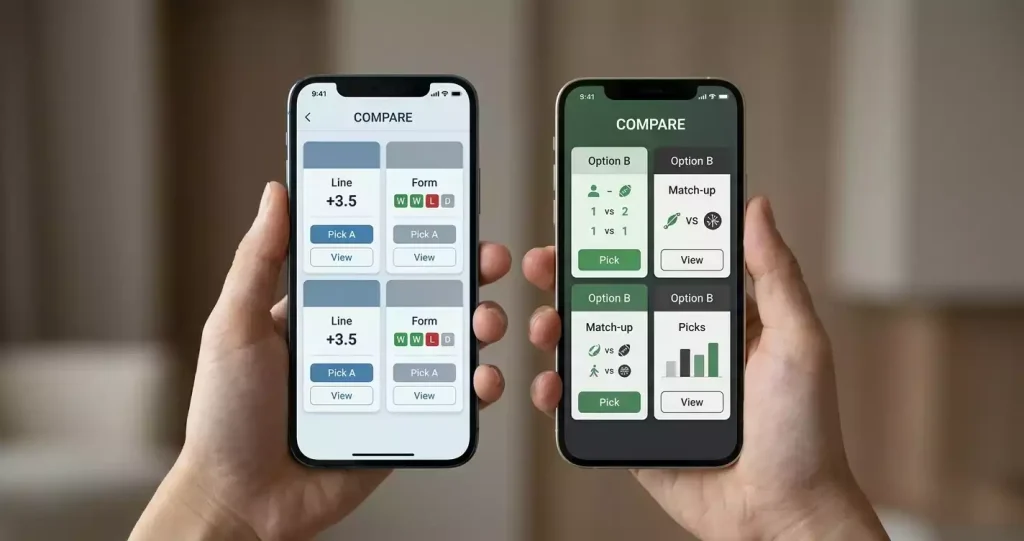
Comparing Divergent Bookmaker Lines for Max Payouts
The same player props are priced differently across UK-licensed operators. I do not mean by a tick or two on the same line — I mean meaningfully different lines, different vig, different over-under splits. Last Wednesday I logged a points prop on the same player at two operators: -115/-105 on book A, -125/+100 on book B. Devigging each market gave fair probabilities of 50% / 50% on book A and 51.5% / 48.5% on book B. The over was better at one operator; the under at the other. The bettor who placed at the wrong book paid roughly 2.5% in implied probability for the same bet.
Multiply that gap across a season of bets and the cost of not shopping is enormous. A bettor placing 200 bets a year, losing 2% of average implied probability per bet to suboptimal lines, gives up roughly 4% of total stake to friction. On a £10,000 turnover, that is £400 of negative expected value imposed by laziness rather than by any model failure.
Why UK Books Diverge on Prop Lines
The divergence is structural. Different operators use different pricing models, different data feeds, and different risk profiles. Two operators looking at the same player can reach different conclusions about his fair line because their inputs differ — one weights last-five-game form heavily, another weights season-long usage. The output diverges, sometimes substantially.
Liquidity also drives spread. A book with thin liquidity on NBA props will widen its vig to protect itself; a book with deep liquidity can price tighter. UKGC data on online real-event betting GGY shows the market reaching £596 million in the most recent reporting period, up 5% year-on-year, but the operator share of that pie is heavily skewed. The top five operators handle the bulk of UK betting volume; the next twenty share the rest. The thinner books in that long tail are where the wider vig lives.
The 40% Remote Gaming Duty effective from 1 April 2026 has added a new variable. UK casino consumers face up to 90% pass-through of that increase, which has tightened operator margins and forced some books to widen vig to preserve hold. The vig on prop markets has crept up by 1-1.5 percentage points across several mid-tier operators since the duty took effect. Bettors who shop are insulating themselves from the cost of that pass-through.
Decimal Versus American Odds in Comparisons
UK books default to fractional odds in their display, but virtually all of them allow toggling to decimal. Compare in decimal. The fractional display is harder to compare across operators because the increments are not standardised — one book shows 4/5, another shows 10/13, and the bettor has to convert both before deciding which is sharper.
Decimal odds make the comparison instant. 1.80 versus 1.83 versus 1.85 on the same line tells you immediately which operator pays best. The 1.85 line carries an implied probability of 54.1%, the 1.80 line 55.6%, the 1.83 line 54.6%. The 1.85 line is the bettor’s friend.
Most retail bettors I know default to whichever app they opened first. The discipline of always comparing two or three operators before betting feels like extra friction, but it pays itself back inside ten bets. The friction is real for the first month and almost zero after that.
The Aggregate Comparison Method
The cleanest line-shopping workflow does not require special tools, just a small spreadsheet. List your typical operators in columns, and for each bet you are considering, log the over price, the under price, and the implied probabilities of both. The operator offering the best price on your side wins the bet.
The Dimers analyst team has noted that the largest edges identified by modelling work belong to player prop bets, and that there is virtually always value to be found across the prop menu. That value is mostly distributed across operators — the same prop will be priced sharply at one book and loosely at another. Identifying the loose pricing on your side is the foundation of long-run profitability.
I cap my line-shopping at three operators. Adding a fourth or fifth book yields marginal incremental improvement and adds substantial workflow friction. The three operators I shop are chosen for their reliability of liquidity on NBA props, the breadth of their prop menu, and the speed of their interface on mobile. Beyond three, the diminishing returns are not worth the effort.
Boosts and Promotional Pricing
UK operators heavily promote boosted prices on selected props. A line that would normally sit at -115 might be boosted to +110 for a 24-hour window. The boost looks attractive, and sometimes it represents real value, but most boosts are marketing tools to drive volume into bets the operator wants to take.
The way to evaluate a boost is to devig the post-boost two-way market — if the operator boosts the over but holds the under at unchanged price, the no-vig fair probability shifts. Sometimes the boost creates positive expected value; sometimes the operator widens the under to absorb the boost on the over, and the no-vig math is unchanged.
The boosts that pay are the ones where the operator is offloading exposure they have already accumulated. Those are rare and worth catching. The boosts that drive volume are far more common and worth ignoring. The devig calculation distinguishes the two.
The Limits and Stake Caps That Punish Shoppers
Operators monitor line shoppers. A bettor who consistently bets the best price across multiple books is, by definition, beating closing line value on most bets. Operators detect this pattern through stake history and account flags, and the response is to cap the bettor’s maximum stake on the operator where he has been most successful.
The cap kicks in at different thresholds by operator. Some books cap at the first sign of CLV, others tolerate larger samples before flagging. The bettor’s response is to size moderately at any single operator and to distribute volume across multiple books — keeping his win rate at any single operator below the flagging threshold while still collecting the best available line each bet.
I keep my per-operator stake on any single bet at around 60% of what each book would theoretically accept. The margin protects me from the cap. The bettor who maxes out the book’s offered cap is announcing his sharpness; the bettor who sits well below it stays anonymous. For the broader frame on how to size bets without triggering operator-side restrictions, see my walkthrough of bankroll management.
Why Speed Matters More Than Number of Books
The choice between three good books and five mediocre ones is straightforward. Three books that load fast, accept your stake immediately, and update their lines reliably are worth more than five books where one of them stalls on a bet and the line moves before the stake confirms.
Speed pays the bettor in the live market specifically. Pre-game line shopping has time to work the comparison. Live shopping has 15-30 seconds to identify the price, place the bet, and confirm. A slow operator turns a bettable price into a missed price. The interface that loads in two seconds and confirms in three is worth more than the interface that loads in five and confirms in seven, regardless of which one shows the better headline price most days.
The bettors who have a stable line-shopping routine running across three reliable operators outperform the ones who chase the absolute best price across seven slow books. The maths is simple — better execution at a slightly worse price beats worse execution at a slightly better price. The 200-bet sample size proves it.
Articles



Written by the editors at HoopMargin.
