
NBA Overtime Prop Settlement & Sportsbook Rules
 Available in US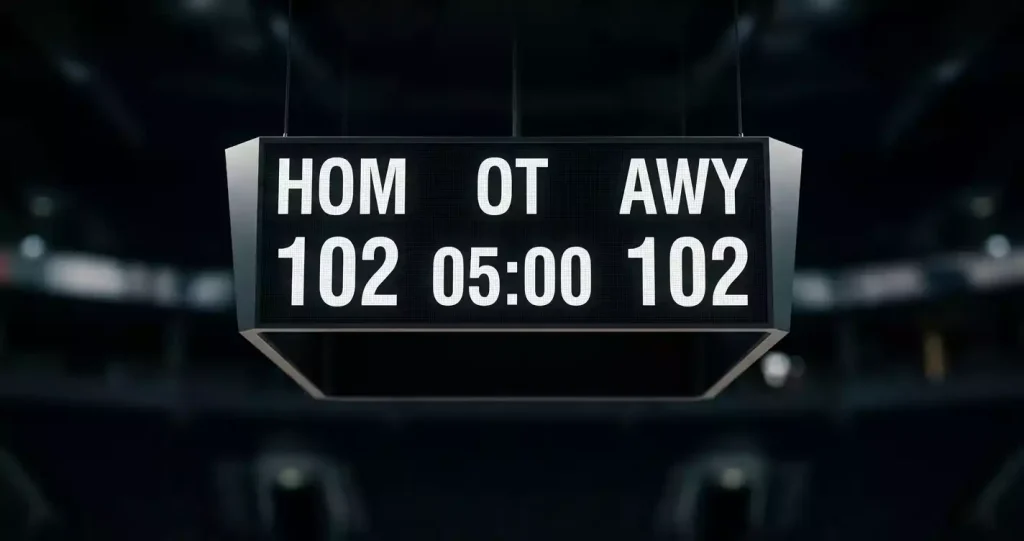
How Extra Periods Shift Total Stat Payouts
Overtime is the rule that catches everyone out at least once. A points over bet sits at 21 points heading into the final two minutes of regulation; the score is tied; both teams have a shot at the win. Overtime arrives, the star scores 8 more points across the extra period, and what looked like a near-miss becomes a comfortable cover. Or the other way: an under that was safe with seconds left on the clock turns into a loss as 5 minutes of extra basketball pile points onto the wrong side of the line.
The rule on UK-licensed books is straightforward — almost all NBA player props settle on total game statistics, which include overtime. The exception is quarter-specific bets, which settle only on the specified period and ignore overtime. A first-half points line is unaffected by overtime; a full-game points line absorbs every overtime point. The distinction matters more than retail bettors usually credit.
How Lines Are Built for Overtime Risk
Bookmakers price most player prop lines on regulation expected production. The overtime contribution is an extra term layered on top — a small expected addition that reflects the probability of overtime occurring multiplied by the expected production in those extra minutes. On a star averaging 25 points per game, the overtime contribution to his expected total is about 0.4 points. The model factors this in. The line you see has already absorbed it.
The overtime rate across the NBA hovers between 6-8% of all games. The number ticks up slightly in high-stakes contexts — close in-conference games, late-season seeding battles, playoff series. The percentage is small but stable, and the expected production in overtime is concentrated heavily on the stars.
The expected-value math is interesting. A 7% overtime rate multiplied by 4-6 points of star production in overtime yields 0.3-0.4 points of overtime contribution per game. That contribution is what is already baked into the line — but it is also the source of the heavy-tail outcomes when overtime actually arrives.
The Star’s Overtime Usage Spike
Overtime concentrates production on the team’s primary creators more than regulation does. Coaches lean on their stars in the 5-minute overtime period; bench players see almost no time unless the foul-out scenario forces it. The star’s usage rate in overtime is typically 5-8 percentage points higher than his game-long average.
For a 30% usage star, overtime usage of 36-38% means he is taking the ball on more than a third of all possessions. The points he produces in those 5 minutes can be enormous — 6-10 points is typical for a top star, and the upper tail extends to 15+ on a hot night. The over bet that looked dead at the end of regulation becomes a freeroll the moment overtime starts, because the star’s 5 minutes are denser than any 5-minute stretch in regulation.
This is why the cash-out price on a falling-short over bet often looks generous when overtime is a live possibility. The book is offering to settle early at a price that ignores the right tail of an overtime outcome. A bettor who passes on the cash-out and lets the bet run captures the overtime upside that the book wants to buy back. For the strategic frame on when to take or refuse a cash-out, see my walkthrough of cash-out strategy on prop bets.
Threes and the Overtime Volume Effect
Three-point lines benefit from overtime more than two-point lines do, in proportional terms. A 5-minute overtime period sees roughly 5-6 three-point attempts on average across both teams — a concentrated burst because tied-game late-clock possessions favour pull-up threes and broken plays. A star at a 3.5 threes line who finishes regulation at 3 has a strong overtime probability of making one more, settling the over.
The 2025-26 NBA prop-tracking model that logs threes at a 63.2% closing-line win rate captures part of this dynamic. The model’s three-point edge is not entirely about volume or matchup; it includes the overtime-adjusted expected production that the public’s modelling does not fully absorb. Three-point unders are systematically riskier than two-point unders because the overtime tail is bigger relative to the line.
I downgrade my under bets on threes lines whenever the spread implies a close game. The downgrade is small — about 5% in implied probability — but it pulls some borderline unders out of the bet category and saves me from the inevitable overtime sting on a few of them each season.
The First-Quarter and First-Half Markets
Quarter-specific and half-specific prop markets settle on the specified period only, ignoring overtime entirely. A first-quarter points line is unaffected by anything that happens after the first quarter. A first-half points line settles at the second-quarter buzzer regardless of game outcome.
The narrower settlement window changes the bet profile. First-quarter unders are not at overtime risk; first-quarter overs do not benefit from overtime upside. The bettor who likes the under on a points line in regulation might prefer the first-half under specifically to remove overtime risk while keeping most of the underlying edge.
The trade-off is line liquidity. First-quarter and first-half lines have lower liquidity than full-game lines, which means wider vig and lower stake caps. The protection from overtime variance comes with a cost. The bettor decides whether the protection is worth the wider price.
Live Markets During the Final Two Minutes
The live market reaches its most volatile state in the final two minutes of regulation when overtime is in play. The over-under prices on full-game lines compress sharply, the spread on points lines widens, and the book’s algorithm is essentially pricing two distinct scenarios — regulation finish and overtime extension — and blending them.
The bettable opportunity is on the prop overs of stars in tied or one-possession games at the two-minute mark. The full-game over price often sits at -110 to -130 when the regulation-only over would be a heavy favourite and the regulation-plus-overtime over should be even more so. The live market is conservative in pricing overtime upside because the operator wants to limit exposure during the most volatile window.
The bettors who consistently make money in this window are doing it with patience, not speed. The price holds at -110 to -130 for the full 90 seconds before the buzzer; there is no rush. The bettor who places the bet at a 30-second hold has the same expected value as the bettor who places at five seconds. The difference is execution risk on the slower book — better to bet at 90 seconds with confidence than at 5 seconds in a panic.
What Voids and What Settles
The void rules vary by operator and bet type. A standard prop bet on a player who plays in regulation but not in overtime still settles normally — overtime is included in the total game stat. A prop bet on a player who is ruled out before tip is voided. A prop bet on a player who plays a minute, gets injured, and is removed from the game settles on his actual production at the moment of removal, with no adjustment for the would-have-played minutes.
The grey area is the player who plays a minute, sits for 47 minutes with no injury news, and returns for overtime. This scenario is rare but it happens. UK-licensed operators handle it by treating the player as having been on the floor for the duration of the game; his prop settles on actual production, which in this scenario is whatever he produces in the minute he played plus whatever happens in overtime.
The settlement variance on these edge cases is real but small. Over a 200-bet annual sample, the bettor will see one or two such cases. They net out to roughly zero expected value on average, but the volatility on the specific bet is high. The defensive approach is to read each operator’s bet rules at account opening and to confirm settlement on any unusual outcome before banking the result.
Articles



Published by the HoopMargin team.
