
NBA Assists Props Betting Systems & Odds Analysis
 Available in US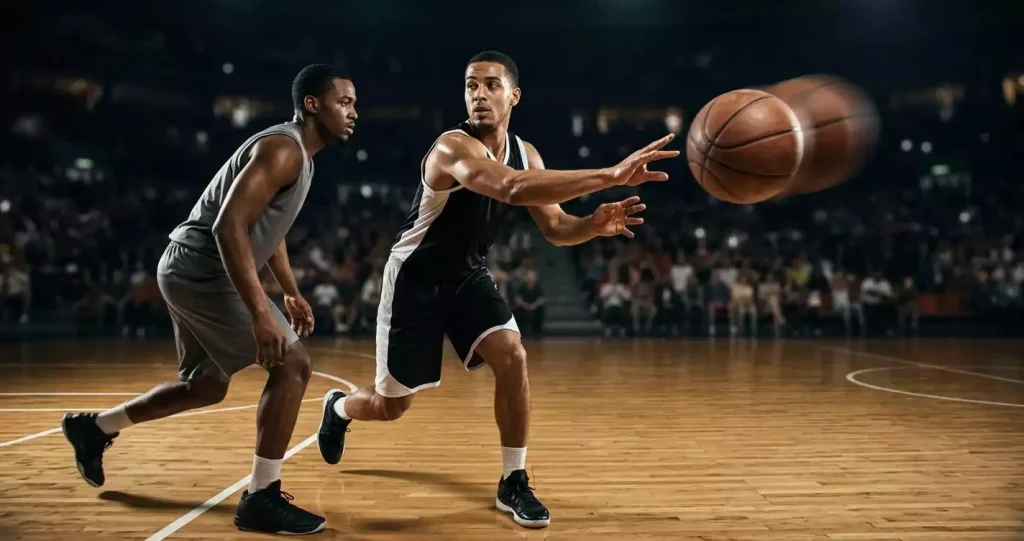
Managing Risk in the NBA Assist Market
Of every single-stat market I have logged across six seasons of NBA props, assists has the widest variance per pound of stake. The Dimers analyst team puts the case bluntly: most days the largest betting edges they find belong to player prop bets rather than traditional moneylines, and there is virtually always good value to be found. I agree on the principle, but assists is the market where that statement does the most damage to bettors who do not understand what an assist actually requires. Projecting assist totals accurately requires a deep dive into the primary ball handler’s NBA usage rate during specific rotation periods.
An assist needs three independent events to align inside a few seconds: the player has to make a pass that creates a shot, the teammate has to take that shot, and the teammate has to make it. Any one of them failing kills the stat. A point guard can have a perfect playmaking night by every other measure — paint touches, drive-and-kick frequency, pull-the-defence chops — and finish with six assists because his teammates went 39% from the field.
One published 2025-26 NBA prop-tracking model logs assists with similar volatility to other high-variance markets — and the win rate even on serviced lines hovers in the 55-60% band, lower than rebounds or blocks. The implication: you need a bigger edge on an assist bet than on most other props to clear the same EV threshold.
Assist Rate and Why It Beats Per-Game Numbers
Per-game assists is the lazy metric. A player at 8.0 assists per game looks like a clean ceiling, but the number conflates skill with opportunity. The same player on a team with cold-shooting wings ends up at 5.5 in a different roster.
Assist rate fixes the framing. It measures the percentage of teammate field goals a player assisted on while he was on the floor. A top-tier playmaker runs at 40-45% assist rate. A secondary creator sits around 25-30%. A spot-up shooter is 8-12%. Those bands hold up better across rosters than per-game numbers, because they normalise for how many shots his teammates take.
I model assist props by multiplying the player’s assist rate by the team’s expected made-field-goal count for the game. A team projected to make 41 field goals, with a primary creator at 38% assist rate playing 34 of 48 minutes, should produce about 11 assists from that creator before adjustments. The adjustments are the interesting part — pace, opponent scheme, teammate shooting variance.
Teammate Shooting Variance and the Assist Ceiling
Here is the part that hurts. Even a perfect playmaking night cannot produce assists without makes at the other end of the pass.
Teammate three-point shooting variance is the biggest killer. A primary creator with three high-volume shooters around him is wonderful when they are at 38%; the assists pile up. The same setup at 28% generates the same shot diet — same paint touches, same kicks, same open looks — but only two-thirds the assists. Three-point shooting from any team for any given night swings by about 8 percentage points around its true rate. That swing alone moves an assist line by two or three.
I look at the team’s three-point variance over the last two weeks before betting any creator’s over. A team riding a hot streak above its season rate is regressing toward the mean, which kills the over. A team in a cold spell below its rate is regressing upward — which helps it.
The catch: bookies see this too. The cleanest spot is when the bookie’s model uses a season-long teammate-shooting baseline while the team is in a real shift — a new lineup, a returning shooter, a coaching adjustment — that has not yet been reflected in the season number.
The Secondary Playmaker Effect
Teams with two playmakers split the pie. That sentence is the most underused filter on assist props.
When a primary point guard plays alongside a secondary creator — a combo guard, a tall forward who initiates offence, a centre with high-post passing — the primary’s assists drop by 1-2 per game on average. Not because he is worse, but because the secondary creator is grabbing some of the assist opportunities. Possessions shift. Inbound passes go to the secondary. A late-clock rescue goes to the player closest to the action, not necessarily the primary.
The cleanest under spot I have hit repeatedly: primary point guard sitting in his normal price band, secondary creator returning from a multi-game absence, line not yet adjusted. That secondary returning is often public information by tip-off, but assist lines move slowly to absorb it. For the matching analytical frame — what happens to usage when a star teammate moves in and out — my walkthrough of usage rate prop betting covers the redistribution side of the same coin.
Blowout Risk on Top Point Guards
The star point guard on a heavy favourite is the trap I see UK bettors fall for most often. The thinking is reasonable on the surface: he is the engine, he will eat minutes, his volume will be huge. In practice, the opposite happens.
If his team is favoured by 12 or more, coaches lean on the deeper bench in the fourth quarter. The starting point guard often plays 28-30 minutes instead of his usual 34-36. Those four lost minutes are concentrated in the fourth, which is also where his playmaking volume peaks in close games. The over needs to be banked in three quarters, which is a fundamentally different proposition than the line implies.
I avoid star point guard overs on spreads of 9 or more unless the line specifically reflects the truncated minutes — and most opening lines do not.
Live Assist Lines: When to Move
Live assist lines redraw every possession, which makes them more responsive than rebound lines but slower than points. The window I look for: the primary creator has a quiet first quarter — say two assists at the buzzer — and the live under price tightens. The model is reading low passing volume.
I check whether the creator’s underlying numbers are normal — paint touches, drive frequency, time of possession — and whether his teammates were just missing shots. If passing volume is intact and the line has compressed on the under, I take the over in the second quarter. The assists will catch up if the underlying activity stays, because three-point shooting regresses inside a single half more often than people expect.
The opposite spot — over priced cheap after a hot first quarter — is harder. Assists do clump, and a hot teammate shooting half can carry an over into a comfortable cruise. The under there needs an injury or scheme change to trigger. Combine these individual player metrics with the comprehensive match analysis available at NBA Player Bets.
Articles

Written by the editors at HoopMargin.
